
Author: Admin
Can the Baby- and Woman-Friendly Maternity Wards Save Lives?

Improving the health and well-being of mothers, infants and children has been an important public-health goal for many countries, which is reflected in the Millennium Development Goals (4 and 5), set by the United Nations. The well-being and health of mothers, infants and children determine future population health and thus public health challenges as well as economic development prospects. Although Ukraine and the other countries of the Former Soviet Union have fared well compared to the less developed countries of Asia, Africa and Latin America, their maternal and infant mortality and morbidity rates are 3 to 5 times higher than those in the European countries (including those of the Former Socialist block). There are many factors behind this situation. Nevertheless, a lot can be done to improve maternal and infant health by simply changing the way labor and delivery services are provided. New evidence-based medicine (EBM) standards introduced by the Mother and Infant Health Project (MIHP) are more baby- and woman-friendly and include: partner deliveries; avoidance of unnecessary C-sections, amniotomies and episiotomies; use of free position during delivery; immediate skin-to-skin contact; early breastfeeding; and the rooming-in of mothers and newborns. The impact of the Project culminates with 3 mothers’ and 11 newborns’ lives saved every two years in an average participating region.
Infant mortality/morbidity has often been a focus of health economics and medical research as a major indicator of a country’s well-being. In contrast, maternal health outcomes have been much less investigated. There are several potential reasons for such negligence. One is that the rates of maternal deaths are quite low in developed countries. The second is attributed to the difficulty of measuring maternal health outcomes in developing countries where the rates of maternal mortality are particularly high. Nevertheless, the issue of maternal health attracts considerable attention from society due to the fact that most of maternal deaths and health deteriorations are preventable. Moreover, recent evidence demonstrates that improvements in health outcomes for mothers and infants are not as much related to the availability of care (structural quality), as to the way this care is provided (process quality) (Barber and Gertler, 2002). Furthermore, some studies find that access to low quality providers in fact contribute to higher child morbidity and mortality (Sodemann et al., 1997).
Although the population health in Ukraine compares favorably to the situation in the developing world, it is still lagging far behind the developed countries in terms of maternal and infant mortality and morbidity. During the latest years, the level of anemia among pregnant women has increased 4.5 times, maladies of genital urinary system about 3 times, and diseases of blood circulation system 2 times. The average maternal mortality ratio fluctuates around 18-22 women per 100,000 live births, which is 3.5 times higher than in the EU. At the same time, infant mortality (9.5/1000) is two times higher than that in the EU, while the rate of stillbirth (16.89/1000) is four times higher. Additionally, the incidence of congenital anomalies of newborns has increased over time and reached the number of 2878 per 100,000, which is 77% higher than the EU average.
Another alarming problem related to maternal health is persistently high rate of abortions, which most likely originates from ignorance in modern family planning methods. In contemporary Ukraine, 71% of pregnancies end up in abortions. Although the number of abortions decreased twice between1991 and 2003 (from 1532/1000 live births to 728/1000 live births respectively), the incidence is still 3.5 times higher than that in the EU (Center of Medical Statistics of Ukraine 2007).
Mother and Infant Health Project Description
The Mother and Infant Health Project is an eight-year project advocating evidence-based medical practices aimed to improve women’s reproductive and newborns’ health. With funding from the USAID and private sources, and with the support from the Ministry of Health of Ukraine, the project has been implemented by the JSI Research and Training Institute. The first phase of the project was initiated in September 2002 in four regions of Ukraine, but the first four maternities joined the Project in mid-December 2003. By the end of 2006, the Project had expanded to 20 maternity hospitals in twelve pilot regions.
Following the Millennium Development Goals (MEU, 2005), the MIHP pioneers to introduce new evidence-based medicine (EBM) standards: partner deliveries; avoidance of unnecessary C-sections, amniotomies and episiotomies; use of free position during delivery; immediate skin-to-skin contact; early breastfeeding; and the rooming-in of mothers and newborns. In addition, the Project actively supports the provision of training on effective perinatal technologies for the staff of the MIHP maternities, development of “centers of excellence” that serve as models in training/education of medical practitioners of the corresponding oblast, and organizing a health awareness campaign on healthy lifestyles. The MIHP also aims to reinforce liaisons with local governmental institutions.
Furthermore, the Project works on integration of the EBM standards into a package of perinatal practices throughout Ukraine. It also targets revision of the current curricula for medical universities and colleges in order to increase the evidence base of educational programs for medical students and health care providers.
The MIHP in Ukraine belongs to a family of maternal and infant health improving initiatives throughout the world and builds upon their experience, JSI Mother Care (1998-2000) being the largest among them. However, the MIHP in Ukraine is unique both with respect to the institutional setting and to its scope and length, which allows for rigorous evaluation. Most of the earlier projects implemented by the JSI have mainly focused on specific issues (e.g. pregnancy of adolescent girls in Uganda and Zambia, anemia in Malawi) and have been short-term (the longest have been two-year projects in Egypt, Pakistan, and Zambia).
The Impact of the Mother and Infant Health Project
The evaluation of the impact of the first phase (2002-2006) of the Mother and Infant Health Project in Ukraine allows for an identification of improvements in the maternal and infant health outcomes due to enhancements in the quality of labor and delivery services. The identification of the quality improvement effect has been possible for two reasons. First, the basic perinatal and obstetrics care is universally available in Ukraine. Hence, the estimated impact of the small region participating in the MIHP can be attributed to the improvement in medical technologies rather than the availability of the services per se. Second, the variation in the project participation over time and across regions allows for control of the overall population health trend in the country.
Taking into account the effect of the other maternal health programs and personnel training outside the Project, Nizalova and Vyshnya (2010) find that the MIHP impact is in general health improving. Decreases in both maternal and infant mortality and morbidity in participating regions are more pronounced after the start of the Project. Among the infant health characteristics, the MIHP impact is observed for stillbirths and infant mortality and morbidity resulted from deviations in perinatal period and congenital anomalies.
Concerning maternal health, the MIHP is most effective in combating anemia, blood circulation, veins, and urinary-genital system complications, and late toxicosis. The analysis suggests that the effects are due to early attendance of antenatal clinics, lower share of C-sections, and greater share of normal deliveries.
For some outcomes (maternal mortality, normal deliveries, and anemia) there exists a significant effect of the MIHP trainings (without joining the Project), although it is about twice as small in magnitude for normal deliveries and anemia than the direct MIHP impact.
Cost-Benefit Considerations
A comprehensive cost-benefit analysis of the MIHP project is limited, since the majority of maternal and infant health indicators are hard to assess in monetary terms (e.g. increase in early neonatal visits of mothers; decrease in the number of cases of late toxicosis and complicated deliveries; decrease in infant morbidity due to various reasons etc.). Therefore, the focus is on the most “tangible” cost effectiveness indicators: (i) average annual per maternity cost of the Project and (ii) average annual per maternity “tangible” benefits.
The average annual per maternity cost is about 60,000 USD and it is calculated as an overall cost of the first phase of the project – 6 million USD – distributed over 20 treatment sites during 2002-2006, including the first year of the Project setup. Set of “tangible” benefits includes savings due to (i) a switch from C-sections to vaginal deliveries (cost savings of around USD 2,500 per maternity per year), (ii) a switch away from medicine-intensive ways of leading both C-sections and vaginal deliveries (around USD 65,000 per maternity per year), and (iii) saved lives of mothers and infants due to the implementation of the MIHP practices (around USD 5.8 million per maternity per year ).
Overall, the project cost to benefit ratio is 1 to 97 (60 to 5,847 thousand USD) if one takes into account the value of lives saved and it is 1 to 1.08 (60 to 65 thousand USD) if one considers only cost savings due to change in C-section and vaginal delivery practices and the switch away from C-sections to vaginal deliveries. The latter represents the lowest bound of the Project’s benefits since it does not take into account any health-improving impact of the MIHP. Although the range is quite wide and this preliminary calculation suffers from several limitations, it seems unlikely that given the estimated impact the true costs would exceed the true benefits.
References
- Barber, Sarah L and Paul J Gertler. 2002. “Child Health And The Quality of Medical Care.” University of California-Berkeley Working Paper .
- Giergiczny, Marek. 2008. “Value of a Statistical Lifethe Case of Poland.” Environmental and Resource Economics 41 (2).
- MEU. 2005. “Millennium Development Goals. Ukraine.” Ministry of Economy of Ukraine .
- Olena Y. Nizalova & Maria Vyshnya, 2010.”Evaluation of the impact of the Mother and Infant Health Project in Ukraine,” Health Economics, John Wiley & Sons, Ltd., vol. 19(S1): 107-125.
- Sodemann, M., M.S. Jakobson, I.C. Molbak, I.C. Alvarenga, and P. Aaby. 1997. “High mortality despite good care-seeking behavior: a community study of childhood deaths in Guinea-Bissau.” Bulletin of the World Health Organization 3 (75):205–12.
Privatization in Belarus – Obstacles and Perspectives

For a long time Belarus considered privatization as a minor factor in influencing the economy’s development, competitiveness and effectiveness. The former economic model relied on concessional loans and donations from Russia and various international organizations. The 2011 financial crisis led to the breakdown of this model and forced the authorities to reconsider privatization. A draft of a new law on investment has been prepared, which is aimed at increasing foreign capital inflow to the country. However, it does not contain sufficient measures to significantly raise the investment attractiveness. In turn the lack of such attractiveness can have a very negative effect on the economy in the near future.
Belarus is right now facing a currency crisis primarily due to three factors:
- A growing deficit of trade and payment balances;
- The National Bank’s continuing Belarusian ruble emission partly because of pre-elective directive wages’ raise;
- A lack of foreign currency reserves required to keep the USD exchange rate at BYR 3100 level.
However, the key problem is a growing negative balance of payments, which in January-June 2011 amounted to USD (-1032.6) million against USD (-82.2) million in January-June 2010.
The Belarusian ruble devaluation, which occurred in May 2011, managed to improve the trade balance situation and gradually lead to export earnings growth. That in turn reduces the current account deficit, which amounted to USD (-1630.4) million in the second quarter of 2011 against USD (-3657.2) million in the first quarter 2011.
Negative foreign trade balance mostly forms negative balance of payments of the country, and problems with external payment capacity are likely to occur under conditions of trade deficit preservation. Moreover, taking into account that the main repayment share of external debt should be paid in 2012-2014 it is necessary to attract additional funding sources.
Table 1. External debt repayment scheme

For this to be feasible privatization as a major long-term capital raising instrument will be required for the following reasons:
- Belarus will not be able to borrow in the external markets in the near future. This is due to impossibility of attracting loans from international organizations as well as extreme expensiveness and inexpedience of sovereign debt securities placement in global stock markets.
- Before the 2011 crisis, public and private companies were able to attract bank and state financing programs’ sources for the financing of their activities. However, the unstable economic situation in the country has forced the authorities to cut the state programs’ funding (BYR 12 trillion instead of requested BYR 36 trillion, while BYR 22 trillion were spent in 2011) in order to prevent further inflation and to provide a budget surplus. Moreover, the economic crises resulted in a decline in domestic demand of the population and the corporate sector simultaneously, with reduced domestic savings levels as a consequence. During the first eleven months of 2011 savings dropped by 25% in USD terms in comparison to the corresponding period of the previous year. These occurrences in the economy make a search of a strategic partner through additional issue of shares or mergers with other agents the only source of financing attraction for state and private companies.
Speaking about the current situation, it should be noted that Belarus planned to get around USD 3 billion from privatization in 2011. 178 assets were to be sold according to the privatization plan. However, just around 38 assets were sold in 2011 and the country managed to gain around BYR 150 billion (USD 17.6 million) from that. Thus, the result cannot get positive evaluation right now.
The main reasons for the slow privatization process and weak foreign capital inflows are the following:
- The multiplicity of agencies responsible for privatization. There are too many responsible decision-makers, which potential buyers have to contact. In addition, it is not very clear which agency is responsible for this or that asset. The State Property Committee and the National Agency for Investments and Privatization (NAIP) supervise the state asset sales today. However, ministries and local authorities are also responsible for privatization plan accomplishment.
- Difference in asset valuation methods. Investors, while analyzing any investment project, tend to focus on the cash flows that the project will be able to generate and how soon the costs will be covered. The Belarusian side values the asset according to its’ book value, below which the price cannot fall. This often results in large price differences.
- Additional requirements. The presence of additional requirements is a common phenomenon, but only when the price negotiations are more flexible. But it distracts investors in case the requirements are followed by a fixed overestimated price.
- Lack of transparency. Periodically the deals are announced, which were closed not during the auctions or tenders but after the closed backroom negotiations. That also affects negatively investors’ opinion about the country
- High share of public sector. Private sector is mostly represented by small and medium businesses. Thus, the strategic investors’ interest in them is initially lower. Moreover, they are unable to invest by themselves due to a lack of resources.
In addition, the authorities and enterprise management demotivation in the privatization process, an undeveloped culture of IR and consulting services usage, and the fact that it is often non-controlling stakes that are put up for sale, are also obstacles in the process.
These are the main problems influencing the foreign capital inflow rates. Their solution and elimination should increase the economy’s investment rates as there is an interest in the country’s assets and it is high enough.
As was mentioned earlier, the sale price of an asset is estimated according to its’ book value in Belarusian rubles. The national currency devaluation, which occurred in May and October 2011, has significantly reduced assets’ real value in USD terms and therefore a sharp drop in prices occurred. Starting from March 2011, the national currency depreciated by 181%, and the fall in real value of assets on sale was comparable. The analysis of transactions, which were closed during the auctions held in 2011, showed that the companies acquired by the investor were generally highly undervalued even in the beginning of 2011.As a result of devaluation, the ratio of asset price to revenue (P/S) dropped by 1.67-1.8 times. OJSC “Zhlobinmebel” (P/S=0.3 January 2011, P/S=0.18 in June 2011), OJSC “Vitebskles” (P/S=0.37 – January 2011, P/S=0.2 – June 2011) .
On the other hand, in accordance with Presidential Decree #476, the revaluation of fixed assets should be done by January 1, 2012 and adjusted to PPI, which equaled to 82% in October, 2011. Such adjustment will still not be able to cover the depreciation resulting from the devaluation. Therefore, there will be a gap between the announced corrected asset price and its real value at least for another year.
Nowadays, the demand is formed by Belarusian export-oriented companies. Their products have become more competative in the markets as a result of devaluation and have caused some growth in earnings. Consequently, they are ready for vertical and horizontal integration with attractive companies operating in the local market in order to expand the production and increase their niche in the global markets.
As for foreign investors, macroeconomic stabilization is necessary in order to make them wanting to enter the Belarusian market. Moreover, foreign buyers are attracted by the strategic Belarusian companies rather than by the small and medium business. This is because they are then able to generate sufficient profit volumes even in the short-term period.
Conclusion
The privatization process will be much more active and intensive in the forthcoming 2012, in comparison to what we have seen during 2011. This is determined on the one hand by a great need in external capital and on the other hand by sufficiently favorable acquisition conditions. However, obviously the privatization process and plan should be reviewed and optimized.
It might be more efficient to put on sale, not just companies’ shares, but also controlling interest as it should increase buyer interest.
It is also possible to sell assets at a minimum fixed price (in case it has losses and no perspectives with current owner), or the authorities could reduce the amount of requirements which accompany the transaction.
Finally, it should be noted that the privatization of small companies will not generate sufficient amounts of foreign capital to the country. In order to achieve that goal, Belarus will have to sell some large strategic assets. It already sold the state’s controlling interest of OJSC “Beltransgaz” to OJSC “Gazprom” for USD 2.5 bln. As for other assets, it is most likely that these will be 51% of shares sale of OJSC “MTS”, 51% shares sale of OJSC “Naftan” in exchange of USD 1 billion syndicated loan issued by “Sberbank Russia” and EABR, as well as a merger of OJSC “MAZ” with Russia’s corporation “Russkie Mashiny” or OJSC “KAMAZ”.
▪
References
http://nbrb.by/statistics/BalPay/Analytical/Current/
http://banki.bel.biz/?p=4167
http://www.interfax.by/news/belarus/101635
http://belstat.gov.by/homep/ru/indicators/doclad/2011_11/6.pdf
http://www.gki.gov.by/about/press/news/e4fc4311733e0af1.html
http://minfin.gov.by/rmenu/departament/itogi-emit/itogi-oao/
http://www.president.gov.by/press127520.html
Russia and the WTO

Eighteen years after the start of the accession process, Russia is closer than ever to joining the World Trade Organization (WTO). The negotiations have been long and hard as Russia had to agree the accession terms with 57 out of the 153 WTO member countries which formed the working group. Moreover, the number of goods for which the extent and timeframe of the change of Russian tariffs were agreed exceeded 10,000. The negotiation team led by Maxim Medvedkov has done an immense amount of work and found compromises on sensitive issues such as pay for the flights of foreign planes over Siberia, compensating European producers for the discriminatory law on industrial assembly, the amount of support for the agricultural sector, access to the market of banking services, etc. Now, all these differences have been ironed out and the WTO has agreed with all the participants, and put on the table the final terms of Russia’s accession.
Terms of Accession
It has to be noted that the change of tariffs after Russia’s accession to the WTO will be insignificant. Average tariffs on goods after all the agreements have come into force will decrease to 7.8% from 10% in 2011.
The tariffs on agricultural goods will drop to 10.8% compared with the current level of 13.2%, and for manufactured goods from 9.5% to 7.3%. The duties on some goods will, however, drop significantly. For example, the tariff on new cars will be cut by half from 30% today to 15%. On the other hand, one has to bear in mind that the agreed decrease of all tariffs will not happen overnight after the Russian accession. It will rather take place gradually at a rate which has also been agreed on with the WTO members. The tariff for new cars will drop to 25% immediately after accession and will remain at that level for the next three years before the cuts resume at an annual rate of 2.5% over the following four years to reach the targeted level of 15%. Russia has no commitments to reduce tariffs any further. The tariffs on used cars up to 7 years old will be fixed at 25% at accession and will not change over the next five years before being cut to 20% over the following two years. Duties on cars older than 7 years will not change at all. On the whole, tariffs will be changed completely immediately upon accession only on one-third of the goods. For many goods the process will extend over three years, and for some over 8 years after accession.
Not only trade in goods, but also service and foreign direct investment spheres will be liberalized. One of the most difficult negotiation items was the banking sector, where some WTO member countries (notably the USA) demanded a total opening up of the Russian market of banking services to foreign financial and lending institutions. Moscow, for its part, insisted on preserving the current situation where only the subsidiaries and not branches of foreign banks operate in the Russian market. The difference between the former and the latter is that the activities of subsidiaries on Russian territory are regulated by the Russian Central Bank, while branches are regulated by the laws of the country of origin. The Russian position prevailed, which means that the situation for foreign banks will not change and the cost of entering the Russian market will remain at the current level. Accordingly, the cost of banking services for Russian clients will not change. This is not good news for Russian small and medium-sized enterprises which had hoped that a massive entry of foreign banks could help bring down the interest rates on loans.
Major changes may take place in the insurance market when Russia allows branches of foreign insurance companies. However, a nine-year transitional period appears to be enough for all the stakeholders to prepare themselves.
Assessment of the Consequences of Russia’s Accession to the WTO for the Economy
The question that is uppermost in the minds of all Russians is whether the economy stands to gain or lose as a result of WTO accession. On the one hand, opponents of accession point to the not very successful experience of accession to the WTO of some former Soviet republics. These opponents paint lurid pictures of the social consequences of the closure of a large number of Russian enterprises. By contrast, the advocates of accession cite the success of China whose export-led growth accelerated significantly after the country joined the WTO. Time will tell what the results of a WTO accession will be for Russia. The result will in many ways depend on well-thought-out and coordinated actions of the Russian federal and regional authorities. In the meantime, we can only talk about what we expect from accession and what its potential consequences may be. The Russian government and the World Bank have conducted several major studies, seeking to determine the economic consequences of a WTO accession. While there are some discrepancies in evaluating the quantitative changes in specific sectors and at the economy-wide level, researchers more or less agree in qualitative terms. The general consensus is that the changes in outputs, consumption, prices and welfare due to the new tariff agreements are likely to be fairly small. Because the overall reduction of import tariffs in Russia will be insignificant, one may expect that changes in specific sectors, too, will not be dramatic (within plus-minus 1-3% of the base level).
CEFIR jointly with the Belgian TML Centre and the German ZEW with the support of the European Union Seventh Framework Programme, recently build a general equilibrium model of the Russian economy SUST-RUS (CEFIR 2011) which makes it possible to assess the effect of a Russian WTO accession on specific sectors. Several scenario calculations have been made to model the short term (one or two years after the reduction of all the tariffs) and long-term (five or six years after the reduction of all the tariffs) effects of a Russian WTO accession. The results of the scenario modeling should be seen as an indication of the direction of market processes caused solely by a WTO accession without taking into account any other possible changes in the economic environment (for example, a change of energy prices, the strengthening or weakening of the ruble against the leading world currencies, changes in the domestic market, etc.).
The short-term scenario assumes only a change of the tariff timetable. The long-term scenario has a further assumption concerning the return on foreign direct investments for the business service sector. Business services include banking insurance, financial services, transport services, wholesale trade, etc. Some terms of Russia’s WTO accession pertain to the business service sphere and envisage considerable liberalization of foreign companies’ access to these sectors. One can expect that lower barriers to entry would push down prices in these sectors and make them more accessible for Russian enterprises, which in turn would reduce their costs, boost production and create more jobs. The general equilibrium modeling of this mechanism assumes a conservative reduction of barriers for foreign investments of about 10% of the current level.
According to CEFIR’s results, the potential growth of welfare in the economy caused by a WTO accession in the short term will be 0.4% per year, and in the long term 1% per year. Budget revenues will fall due to diminished tariffs, and there may be a dip in the rate of GDP growth in the short term. Model calculations show a significant change of the trade balance, possibly a reduction of the trade surplus to 10%. At the sectorial level, a WTO accession will reduce domestic prices of timber and articles made from wood, foodstuffs, transport means, as well as equipment, clothes, chemicals and petrochemical products by 1.5-2.5% in the short term and by up to 3% in the long term. This will increase consumption by between 0.2% and 0.4% in the short term and up to 1.5% in the long term. It has to be noted that the liberalization of the service sphere is a very important assumption of these calculations as it accounts for half of the long-term gains for consumers.
The World Bank has also carried out a study of the consequences of a Russian accession to the WTO in 2004 (Jensen et al, 2004). That study put the net positive gain from liberalization of tariffs at 3.4% of the GDP. That analysis was based above all on the economic effect from a change in import tariffs. Trade liberalization is historically associated with lower tariffs. Most sectors stand to gain from accession. Because the authors identify two main causes of the gains from liberalization – easier access to foreign markets and cheapening of the ruble in proportion to the change of tariffs – the sectors that will benefit are those which has a high share of exports, and which have not been heavily protected by tariffs to begin with.
The biggest beneficiary will be metallurgy, with a 25% increase in output and employment in ferrous metallurgy and 15% in non-ferrous metallurgy. The growth in the chemical and petrochemical industries can be up to 10% and in coal mining up to 6%. The significant gains predicted by the World Bank study owe something to the optimistic view of the possible terms of Russia’s accession to the WTO. For example, it assumed that all the import tariffs would be cut by 50% and all (100%) of the administrative barriers to investment in business services would be removed. More modest assessments of the potential gains for Russia in other studies reflect the smaller Russian commitments to liberalization of import tariffs and the services sphere. For example, CEFIR’s results show that steel-making enterprises will not experience difficulties after a WTO accession and may grow by about 2% in the long term.
Along with the cut of import duties, Russian producers will face tougher competition on the part of foreign goods for which prices will be cut. Accordingly, Russian producers will also have to cut their prices to be competitive. This is good news for consumers. Not all domestic producers will be able to cut their prices. The enterprises whose production costs turn out to be higher than the new prices, and which fail to cut their costs, will be pushed out of the market. The sectors where one can expect a drop in production are above all those which have long been protected against international competition by high import duties. CEFIR’s study has shown that in the short term, negative consequences may ensue for the food industry, pharmaceutical companies and textile enterprises which may see their output drop by between 0.5% and 2%.
According to the World Bank study, the biggest decline in output and employment may occur in the machine-building sector (12%) and in the food and light industries as well as in the construction-material industry (up to 7%). The above figures of decrease or increase refer to the summary effect from liberalization accumulated over a period of 7-10 years after a Russian accession to the WTO. Several studies have been devoted to the consequences of a WTO accession for regional economies. For example, World Bank experts (Rutherford and Tarr, 2006) point to positive, but uneven consequences of a WTO accession for Russian regions. The biggest beneficiaries from lower tariffs are likely to be the Tyumen region, the North Western District as a whole, and in particular, St. Petersburg, where welfare may increase by 1%. Low growth or no growth may be expected in the Central District and in the Urals. These results tally with the assessments of the consequences of WTO accession for the Russian regions made by the Independent Social Policy Institute (ISPI 2004) which also included some regions of the Volga Federal District among the high-risk regions.
Results of studies of changes in the labor market in the wake of WTO accession, generally accord with the other findings. The International Labor Organization (ILO 2003) predicts an average loss of 6000 jobs in industry in the year following accession and up to 1000 jobs in seven or eight years’ time. The biggest number of jobs will be lost in the light-industry sector (up to 15,000 during the transitional period). Such a drop in employment will hardly make any difference to the unemployment situation in the country as whole, but may differ from one region to another.
Most studies agree that Russia may gain from easier access for Russian enterprises to foreign markets after a WTO accession, but that the gain will not be great compared to the potential gain from the liberalization of the service sphere. There are not many export-oriented enterprises in the country, but they exist. There are about 6,000 export-oriented enterprises in the processing industry. These enterprises include chemical, metallurgical and high-tech enterprises, and are the most efficient and competitive producers in the country. These enterprises may be expected to pick up the slack in the labor market due to redundancies in sectors that will be affected by a WTO accession. The coordinating role of the state is very important in creating conditions for movement of labor. The gradual reduction of tariffs may dampen the social consequences of Russia’s WTO accession. In the regions where some production facilities are “doomed”, programs for retraining of labor must be launched without delay, especially in information technologies, and the services and skills required for starting a new business. The aim of such retraining should be to enable those who lose their jobs to be employed in other spheres of the economy. It is equally important to develop new forms of financing migration of the population within the country. The solution of this task may become one more – and very important – result of the WTO accession for Russia.
References
- CEFIR. 2011. SUST-RUS project. www.sust-rus.org
- ILO. 2003. “Social consequences of Russia accession to WTO.” Moscow office of ILO (in Russian)
- ISPI. 2004. “Russia’s accession to WTO: real and imaginary social consequences.” (In Russian)
- Jensen, Rutherford, Tarr. 2004. “Economy-Wide and Sector Effects of Russia’s Accession to the WTO.” World Bank
- Rutherford, Tarr. 2006. “Regional Impacts of Russia’s Accession to the WTO.” The World Bank
Does Service-Sector Liberalization Increase Productivity in the Manufacturing Sector?

Authors: Oleksandr Shepotylo and Volodymyr Vakhitov, KEI.
This policy brief summarizes the results of recent research on the effect of service-sector liberalization in Ukraine, 2001-2007, on productivity in the manufacturing sector. We use a sample of manufacturing firms and construct a firm-specific index of service-sector liberalization. We find that the manufacturing firms which more intensively use liberalized services, on average, have gained 9 percent in total factor productivity (TFP). The service liberalization is associated with increased foreign presence which also has a positive and significant effect on TFP. The effect is stronger for domestic and small firms.
A Resonant Signal: the Russian Parliamentary Elections of December 2011

Days before December 4, prospects of electoral democracy in Russia looked bleak. Consolidation of the authoritarian rule of Vladimir Putin, Russia’s paramount leader since 1999, adoption of non-democratic electoral laws and politically-motivated law enforcement, constant harassment of media, civil society organizations, and election observers, and outright involvement of the government in the electoral process gave little hope that elections would make the political leadership accountable. The courts and electoral officials were used to prevent most opposition leaders from registering a party or participating in elections; opposition financial supporters had been driven into exile. Parliamentary elections in December 2007 and presidential elections in March 2008 were marred by such irregularities that many observers, myself included, had stopped counting. However, the outcome of December 4, 2011 will arguably have a major impact on future political developments in Russia.
Firstly, the official results of United Russia, the party that is led by Vladimir Putin and had a constitutional majority in the previous parliament, showed a significant drop in support for the current political leadership among the general public. Despite overwhelming presence on state-controlled TV channels, significant support by government officials, and outright vote fraud, the official results show the ruling party deserted by more than a quarter of its supporters (12.8 million out of 44.7 million who voted for United Russia in 2007).
Secondly, those who turned out to vote (the turnout was significantly lower than at previous parliamentary elections) showed obvious discontent with Putin/United Russia policy and, possibly, with the way elections were conducted. In particular, millions of Russians voted for Just Russia, a party with no charismatic leader and a platform that is not substantively different from that of United Russia.
Thirdly – and perhaps most importantly – there was a visible and dramatic upsurge of voter activism on the Election Day. Without any large-scale centrally organized campaign, hundreds of volunteers went to polling stations to work as election observers. They witnessed, prevented and/or reported hundreds of violations by electoral officials via social networks (despite coordinated DDoS attacks on the most important networks and popular news sites on the Election Day) and via You Tube. By December 5, some of the You Tube clips showing electoral fraud had more than 1,000,000 hits.
Reported Results and Corrections for Voter Fraud
As is always the case in a semi-democratic state, result of the official count may deviate significantly from how people actually voted. In Russia, the parliament is formed by representatives of political parties: voters vote for party lists, rather than for individual candidates. The officially announced results were: 49.5 percent for United Russia, 19.2 for Communist party, 13.2 for Just Russia, and 11.7 for the Liberal Democrats (Vladimir Zhirinovsky). Other parties, including Yabloko, the only liberal-leaning party that was allowed to participate in elections, fell short of the 7 percent required to enter parliament. However, the observations of international observers concur with those of opposition parties and independent Russian observers: ballot stuffing in favor of United Russia was witnessed/recorded and was widespread; electoral laws, draconian in themselves, were grossly violated by state officials, including police, at polling stations. In a number of cases, the elections results certified by local election boards do not coincide with the data presented by the central electoral commission, with every major discrepancy being in favor of United Russia.
Results obtained by the Citizen Observer project, which brought about 500 Moscovites to 160 polling stations as observers, give an impression of the scale of the fraud. Unfortunately, the project did not use a randomized distribution of observers, which would make the sample statistically representative of the whole of Moscow. However, Moscow districts have demonstrated fairly homogenous voting patterns in the last two decades, and there is no reason to think that any major change in this pattern occurred, so the report offers a fairly reliable estimate of election fraud. Averaging across polling stations where the observers did not report any serious violations, the Communist party won 25.3 percent of votes, United Russia 23.4, Just Russia and Yabloko 17.6 percent each, and the Liberal Democrats 12.5 percent. Turnout was 49 percent.
I would therefore estimate the effects of irregularities at 10 percentage points, i.e. the real share of votes cast for United Russia nationwide would be 39 percent rather than the reported 49 percent. But it would be reasonable to suppose the effect of irregularities at between 7 and 15 percentage points, so real votes for United Russia would be between 34 and 42 percent of votes cast. It is conceivable that the real share of votes cast for the Communist Party in Moscow (19.4 percent in official returns) was close to that of United Russia; it is not inconceivable that the Communists won the majority of real (not “counted”) votes by Moscovites.
Explanations
Following such a major surprise, any explanation offered only three days after the event risks being way off mark. Public opinion surveys predicted a significantly larger plurality for United Russia. (Personally, I have doubts about the quality of surveys of electoral intentions by major Russian polling firms. I find it particularly disturbing that, in the past, such firms have proved good at predicting – supposedly based on voter intentions – the reported results, rather than the results as adjusted by a realistic estimate of electoral fraud.)
The most obvious explanation for the United Russia setback is economic. Russia suffered more than any other G20 country as a result of the world financial crisis in 2008-09: an EBRD Transition Report 2011 found, based on an extensive survey of Russian citizens, that 38 percent of households had to cut their food consumption as a result of the crisis (11 percent of West European households were affected the same way). This is a major impact. In a democracy, such economic impact alone would most probably result in loss of power for the incumbent leadership.
Another explanation is growing discontent among Russians with the harshness of Putin’s administration and with rampant corruption. When oil prices were rising and real incomes were growing by double digits, the Russian public exhibited markedly high tolerance even when political decisions ran contrary to the will of the majority (for example, no opinion survey in five years showed majority approval of the abolition of regional gubernatorial elections, which was a cornerstone of Putin’s political changes) or when they had to pay substantial corruption premiums in the marketplace. In harder times, people are less willing to have their wishes ignored or to tolerate high and rising prices.
Consequences
In the Yeltsin era, such an outcome of parliamentary elections (even by the official count, United Russia lost almost 13 million votes as compared to 2007) would have triggered a major change in the composition of the cabinet. In 2011, there is even more reason for such a change: a number of prominent cabinet members, who had remits to run United Russia slates in specific provinces led their slates to dismal results (low 30s by the official count). However, low mobility in the upper echelons of the Russian elite during the last decade suggests that drastic changes in the near future are unlikely.
More important than the loss of seats in parliament for United Russia is the possibility that Vladimir Putin, the current prime minister with de facto presidential powers and the head of United Russia, is no longer assured a safe victory in March 2012 presidential elections, which looked a foregone conclusion just a couple of months ago. He is still arguably the favorite, even if (very improbably) there is no ban on opposition candidates participating in the elections (in 2008, the field was restricted to three contenders, all of them effectively pseudo-candidates; in 2004, other candidates were de facto prohibited from raising money for the campaign, while the incumbent had the full capacity of the state at his disposal). With a ban on opposition participation, he is the overwhelming favorite. However, we do not rule out an initiative by the government to make outcome of presidential elections even more secure in the near future by a major crackdown on the opposition.
▪
Five Million Tourists in Georgia by 2015 – a Myth or a Nightmarish Reality?

Anybody traveling on the Georgian countryside will be astonished by the pace of development. Mestia, the capital of Svaneti, resembles one big construction site. The new concrete road from Zugdidi promises to shorten the travel time to 2 hours. A whole network of ski lifts is currently being planned, carrying a promise of turning Svaneti, a long-isolated region of Georgia, into the Switzerland of the Caucasus.
Mestia and Svaneti are representative of a broader effort by the Georgian government, assisted by international financial institutions, to develop the Georgian tourism sector. This has mainly involved infrastructure projects and tax breaks to encourage private investment in the tourism industry. A very partial list of touristic destinations that have received or are receiving a major facelift includes Old Tbilisi, Mtskheta, Signagi, Kutaisi, Gudauri, Mestia, Batumi, Kobuleti and Anaklia.
Tourism is one of Georgia’s main exporting sectors and earns hard currency and helps to reduce the current account deficit. As a labor intensive industry, it helps to create a lot of formal and informal jobs (particularly in the periphery where they are most needed). The growth in tourism also spurs business development in many related sectors of the economy – agriculture, transportation services, arts and crafts to name just a few.
Georgia is not the only country in the world riding on the wave of tourism expansion. Tourism is currently the fastest growing sector in the global economy, particularly important for developing countries. According to UNWTO tourism barometer, the flow of foreign tourists into developing countries increased by 4.5% in 2011 compared to the previous year. The rate of increase stands at 9% for Central and Eastern European countries.
For Georgia, however, the growth of tourism has been truly spectacular. According to the Georgian Border Security statistics, the number of foreigners visiting Georgia during the first 10 months in 2011 increased by 42% compared to the same period last year. While not reflecting the actual number of tourists (as opposed to foreigners working in Georgia and buyers of re-exported cars), these data illustrate a steep upward trend. Even under most conservative assumptions, the total number of border crossings by foreigners will reach about 2.6 million by the end of 2011, which is 28% above the 2010 level.
Since 2004, incoming tourism has expanded at an impressive average rate of 32% per year, nearly doubling every three years. A simple (simplistic) extrapolation suggests that in four more years, by 2015, Georgia may be receiving more than 5million tourists a year. Is this a realistic estimate? Would it be a blessing or a curse?

What the border crossings statistics conceal is that Georgia remains a very expensive destination, especially during the short high season. According to Travel and Tourism Competitiveness Index for 2011, Georgia is ranked 73rd among 139 countries, the same ranking as in 2009. In particular, Georgia ranked 82nd on information and communication technologies, 105th on air transportation infrastructure and 94th on general infrastructure. Overall, Georgia does better than its South Caucasus neighbors Armenia (100th) and Azerbaijan (87th) but worse than Russia (53rd) and Turkey (50th).
At present, tourists are willing to pay a significant premium to satisfy their curiosity for this Eastern outpost of Western civilization. Despite high prices and mediocre quality of services, Georgia has so far been able to maintain its attraction as an island of democracy; exotic, underexplored and yet secure location with good food and wine. However, as the country enters a period of two closely watched elections in 2012 and 2013, what will be at stake, among other things, is Georgia’s status as a destination of choice for investors, donors, and tourists. As far as mass tourism is concerned, a setback in the global public relations battle could bring into play the “value for money“ factor, making further expansion in the sector more tightly related to infrastructure and service improvements.
Slower growth in tourism may be a blessing in disguise. From the purely economic point of view one has to consider the impact of tourism on long-term economic growth. Unfortunately, tourism – like many other labor intensive service industries – has little potential for substantial productivity growth: it takes about the same amount of labor to cook one khachapuri today as it did in the 19th century. As wages are typically tied to productivity this means that tourism has little potential for long-term income growth. Wages in tourism may eventually increase – a phenomenon known to economists as “Baumol’s cost disease” – when other sectors improve their productivity and start competing for workers with the tourism industry.
Thus, the Georgian government should be advised to worry, not about the sheer number of tourists, but rather the amount of money the tourists spend in the country. According to this view, Georgia should strive to increase the share of relatively wealthy tourists from Western Europe and North America. These tourists account for a meager 3.6% of total border crossings by foreigners in the first 10 months of 2011. A closely related goal should be to smooth the sharp seasonal fluctuations currently plaguing the industry. High season tourism (mainly from the CIS) at “peak load” prices has been growing so far, but there is ultimately a limit to how many tourists Batumi, Kobuleti and Anaklia can absorb in July and August. After all, there are cheaper and better mass-tourism alternatives on the Turkish side of the border. Conversely, increasing offseason tourism would help attract additional investment in human and physical capital and raise the quality of services to a level appropriate for high-end tourism.
Along with the economic pitfalls outlined above, the danger associated with becoming just another “Disneyland” of mass tourism is in losing the very reason why people would want to come to Georgia, as well as losing a part of the national identity. The magnificence of Georgian landscapes is in the wild, untamed nature of their beauty. It is also one of the very few places in Europe where one can still witness and appreciate the tenacity and courage of people who do not merely survive, but “live with” the land, with the nature that is both generous and unforgiving.
Of course, we almost always accept as inevitable the sacrifice of “tradition” for “progress”. Most of the time, it is difficult to tell whether the changes we are going through are for the better or for the worse. In particular, it may depend on what people perceive to be the “core” of their identity. Our feeling is that Georgians as a people have been formed to a great extent by the freedom, the wilderness, and the power of their mountains. Any successful and smart approach to developing the tourism industry would take into consideration these important cultural aspects as well.
▪
Development Programs and Security in Afghanistan

This policy brief summarizes the results of recent research which studies the effect of a development program in Afghanistan on the security situation there. We use a large-scale randomized field experiment to examine the effect of the largest development program in Afghanistan on the economic wellbeing of villagers and their attitudes toward the government and the security situation. We find that implementation of the program leads to significant improvement in villagers’ economic wellbeing as well as in their attitudes towards the government. The program also leads to an improved security situation in the long run. However, these positive effects on attitudes and security are not observed in districts with high levels of initial violence.
Development programs have long been used to promote economic and political development. In recent years, however, they have assumed yet another role: they have been used to promote security in countries fighting fierce insurgencies, such as Afghanistan and Iraq. The approach contends that such projects, which are commonly used by the domestic government and allied entities to provide basic services and infrastructure, improve economic outcomes, build support for the government, and ultimately reduce violence as sympathy of the population for the insurgency wanes. The idea of using development projects as a counter-insurgency strategy is becoming more and more influential and now constitutes a major component of the new U.S. counterinsurgency doctrine (U.S. Army/Marine Corps, 2006).
The study tests whether this approach works in the context of the National Solidarity Program (NSP) in Afghanistan. NSP is the largest development program in the country and has already brought almost $1 billion in aid to more than 26,000 Afghan communities. Under the supervision of the program communities elect a council, which assumes responsibility for implementing infrastructure projects (e.g. building wells or repairing roads) that are chosen by the villagers and are funded by block grants from the NSP.
To measure the effects of the program, the study uses a field experiment conducted in 500 villages across 10 Afghan districts spanning all parts of the country except for the southern provinces, where security levels were insufficient for the study to be carried out. The experiment divided the villages randomly into two groups of the same size, one of which received the program in autumn 2007, while the other group was to receive the program four years later. Before the start of the program the villages in these two groups were virtually identical, so their comparison over the course of these years shows the effect of the program on the life of village communities. The study uses the results of the extensive survey conducted in these villages two years after the start of the program as well as military information on security incidents around the villages during this period.
Our findings indicate that NSP has a strong positive effect on people’s economic wellbeing and on their attitudes towards the Afghan government (both at the central and local level). NSP also appears to improve attitudes toward NGOs and, to some extent, coalition forces on the ground. Respondents in NSP villages have significantly more positive attitudes toward government figures at almost all levels, including district and provincial governors, central government officials, the President of Afghanistan, Members of Parliament and government judges. Magnitude of effects varies from between 8 percentage points for Members of Parliament to 4 percentage points for the national police. NSP also has a positive effect on the attitudes of villagers toward NGOs and soldiers of the International Security Assistance Force (ISAF). The results for the summary measure indicate that NSPs improve villagers’ attitudes by 13 percent of a standard deviation. However, results for the two eastern districts, which experienced high initial levels of violence, are completely different. There is no positive effect of NSP on attitudes toward any government bodies, ISAF soldiers, or NGOs, and the effect on attitudes towards many figures is, in fact, significantly negative.
The results also indicate that villagers have more positive perceptions about security in NSP villages. There is no evidence, however, that the program affects the number of security incidents around villages recorded by NATO coalition forces (ISAF) in the short run (the first 15 months after the start of the program) or the number of security incidents reported by villagers in the survey. However, NSP does reduce the probability of security incidents in the long-run. The probability that a security incident will occur in one- and ten-kilometer radius around a village is smaller in treatment villages by 2 and 4 percentage points, respectively. For a three-kilometer radius, the probability is lower by 2 percentage points, but not statistically significant. In the two eastern districts, the short-run effect is similar to the average effect, but there are no statistically significant differences between treatment and control villages in long-run effects.
Overall, the empirical evidence suggests that strategies for winning the “hearts and minds” through the provision of development projects are working, but only in relatively secure regions. The development program improves the attitudes of the civilian population toward the government and makes them more likely to think that the government is working in their best interest, which in turn makes them less likely to support the insurgents. The fact that we observe the effect on security only in the long run suggests that support for the government reduces violence mainly by reducing the number of people willing to join the insurgents, rather than by increasing the population’s willingness to share information with the government. The results also suggest that development programs can prevent the spread of violence in relatively secure regions, but they are not effective in reducing violence in regions that are already experiencing significant security problems.
Overall, the results suggest that the benefits of development programs are not limited to the provision of direct economic and social benefits. They can also contribute to long-term sustained development by preventing the spread of violent internal conflicts, which are the core problem in many developing countries.
Disclaimer: Opinions expressed in policy briefs and other publications are those of the authors; they do not necessarily reflect those of the FREE Network and its research institutes.
▪
Are Natural Resources Good or Bad for Development?

Natural resources development undoubtedly plays an important role in the economies of many countries. Whether their contribution to development is positive or negative is, however, a contested and difficult question. Arguably, countries like Australia, Botswana, and Norway have gained enormously over long periods from sustained natural resources development. Others, such as Azerbaijan, Kazakhstan, and Russia, have achieved significant economic growth through natural resources development but perhaps at the expense of institutional progress. In contrast, in some countries—such as Angola and Sierra Leone—natural resources development has been at the heart of violent conflicts, with devastating consequences for society. With many developing countries being highly resource-dependent, a deeper understanding of the sources of success and the risks associated with natural resources development is highly relevant. This brief reviews the main issues and points to key policy challenges for transforming resource rents from natural resources development into a driver rather than a detriment to overall development.
Is it good for a country to be rich in natural resources? Superficially, the answer to this question would obviously seem to be “yes”. How could it ever be negative to have something in addition to labor and produced capital? How could it be negative to have something valuable “for free”? Yet, the answer is far from that simple and one can relatively quickly come up with counterarguments: “Having natural resources takes away incentives to develop other areas of the economy which are potentially more important for long-run growth”; “Natural resource-income can cause corruption or be a source of conflict”, etc.
Looking at some of the starkest cases, the “benefits” of resources can indeed be questioned. Take the Democratic Republic of Congo for example. It is the world’s largest producer of cobalt (49% of the world’s production in 2009) and of industrial diamonds (30%). It is also a large producer of gemstone diamonds (6%), it has around 2/3 of the world’s deposits of coltan and significant deposits of copper and tin. At the same time, it has the world’s worst growth rate and the 8th lowest GDP per capita over the last 40 years.[1] The picture for Sierra Leone and Liberia is very similar – they possess immense natural wealth, yet they are found among the worst performers both in terms of economic growth and GDP per capita. While the experiences of countries such as Bolivia and Venezuela are not as extreme their resource wealth in terms of natural gas and oil, respectively, seems to have brought serious problems in terms of low growth, increased inequality and corruption. When one, on top of this, adds that some of the world’s fastest-growing economies over the past decades – such as Hong Kong, South Korea and Singapore – have no natural wealth the picture that emerges is that resources seem to be negative for development.
These are not isolated examples. By now, it is a well-established fact that there is a robust negative relationship between a country’s share of primary exports in GDP and its subsequent economic growth. This relationship, first established in the seminal paper by Sachs & Warner (1995) is the basis for what is often referred to as the resource curse, that is, the idea that resource dependence undermines long-run economic performance.[2]
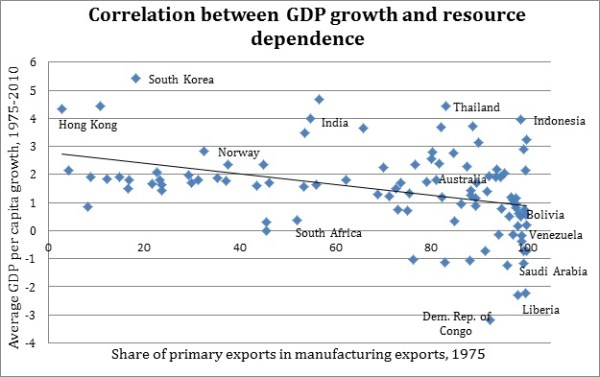
Based on the World Development Indicators database (World Bank). Primary exports consist of agricultural raw materials exports, fuel exports, ores and metals, and food exports.
At the same time, there are numerous countries that provide counterexamples to this idea. Being the second largest exporter of natural gas and the fifth largest of oil, Norway is one of the richest world economies. Botswana produces 29% of the world’s gemstone diamonds and has been one of the fastest-growing countries over the last 40 years. Australia, Chile, and Malaysia are other examples of countries that have performed well, not just despite their resource wealth, but, to a large extent, due to it.
Given these examples the relevant question becomes not “Are resources good or bad for development?” but rather “Under what circumstances are resources good and when are they bad for development?. As Rick van der Ploeg (2011) puts it in a recent overview: “the interesting question is why some resource-rich economies [.] are successful while others [.] perform badly despite their immense natural wealth”. To begin to answer this question it is useful to first review some of the many theoretical explanations that have been suggested and to see what empirical support they have received. Clearly, our overview is far from complete but we think it gives a fair picture of how we have arrived at our current stage of knowledge.[3]
Theories and Evidence
The most well-known economic explanation of the resources curse suggests that a resource windfall generates additional wealth, which raises the prices of non-tradable goods, such as services. This, in turn, leads to real exchange rate appreciation and higher wages in the service sector. The resulting reallocation of capital and labor to the non-tradable sector and to the resource sector causes the manufacturing sector to contract (so-called “de-industrialization”). This mechanism is usually referred to as “Dutch disease” due to the real exchange rate appreciation and decrease in manufacturing exports observed in the Netherlands following the discovery of North Sea gas in the late 1950s. Of course, the contraction of the manufacturing sector is not necessarily harmful per se, but if manufacturing has a higher impact on human capital development, product quality improvements and on the development of new products, this development lowers long-run growth.[4] Other theories have focused on the problems related to the increased volatility that comes with high resource dependence. In particular, it has been suggested that irreversible and long-term investments such as education decrease as volatility goes up. If human capital accumulation is important for long-run growth this is yet another potential problem of resource wealth.
The empirical support for the Dutch disease and related mechanisms is mixed. Some authors find that a resource boom causes a decline in manufacturing exports and an expansion of the service sector (e.g. Harding and Venables (2010)), others do not (e.g. Sala-i-Martin and Subramanian (2003)). But even the studies that do find evidence of the Dutch disease mechanism, usually do not analyze its effect on the growth rates. In principle, Dutch disease could be at work without this hurting growth. Another problem is that the Dutch disease theory suggests that natural resources are equally bad for development across countries. This means that the theories cannot account for the great heterogeneity of observed outcomes, that is, they cannot explain why some countries fail and others succeed at a given level of resource dependence. The same goes for the possibility that natural resources create disincentives for education. Gylfason 2001, Stijns (2006) and Suslova and Volchkova (2007) find evidence of lower human capital investment in resource-rich countries but the theory cannot explain differences across (equally) resource-rich countries.
As a result, greater attention has been devoted to the political-economic explanations of the resource curse. The main idea in recent work is that the impact of resources on development is heavily dependent on the institutional environment. If the institutions provide good protection of property rights and are favourable to productive and entrepreneurial activities, natural resources are likely to benefit the economy by being a source of income, new investment opportunities, and of potential positive spillovers to the rest of the economy. However, if property rights are insecure and institutions are “grabber-friendly”, the resource windfall instead gives rise to rent-seeking, corruption and conflict, which have a negative effect on the country’s development and growth. In short, resources have different effects depending on the institutional environment. If institutions are good enough resources have a positive effect on economic outcomes, if institutions are bad, so are resources for development.
Mehlum, Moene and Torvik (2006) develop a theoretical model for this effect and also find empirical support for the idea. In resource-rich countries with bad institutions incentives become geared towards “grabbing resource rents” while in countries where institutions render such activities difficult resources contribute positively to growth. Boschini, Pettersson and Roine (2007) provide a similar explanation but also stress the importance of the type of resources that dominate. They show that if a country’s institutions are bad, “appropriable” resources (i.e., resources that are more valuable, more concentrated geographically, easier to transport etc. – such as gold or diamonds) are more “dangerous” for economic growth. The effect is reversed for good institutions – gold and diamonds do more good than less appropriable resources. In turn, better institutions are more important in avoiding the resource curse with precious metals and diamonds than with mineral production. The following graph illustrates their result by showing the marginal effects of different resources on growth for varying institutional quality. Distinguishing the growth contribution of mineral production in countries with good institutions with the effect in countries with bad institutions, the left panel shows a positive effect in the former and a negative one in the latter case. The right-hand panel illustrates the corresponding, steeper effects when isolating only precious metals and diamond production.

Even if these papers provide important insights and allow for the possibility of similar resource endowments having variable effects depending on the institutional setting, two major problems still remain. First, the measures of “institutional quality” are broad averages of institutional outcomes (rather than rules).[5] Even if Boschini et al. (2007), and in particular Boschini, Pettersson and Roine (2011) test the robustness of the interaction result using alternative institutional measures (including the Polity IV measure of the degree of democracy) it remains an important issue to understand more precisely which aspects of institutions that matter. An attempt at studying a particular aspect of this question is the paper by Andersen and Aslaksen (2008), which shows that presidential democracies are subject to the resource curse, while it is not present in parliamentary democracies. They argue that this result is due to higher accountability and better representation of the parliamentary regimes.
A second remaining issue is that even if one concludes that the impact of natural resources differs across institutional environments it is an obvious possibility that natural resources have an impact on the chosen policies and institutional arrangements. For example, access to resource rents may provide additional incentives for the current ruler to stay in power and to block institutional reforms that threaten his power, such as democratization. In a well-known paper with the catchy title “Does oil hinder democracy?” Ross (2001) uses pooled cross-country data to establish a negative correlation between resource dependence and democracy.
However, one needs to be careful in distinguishing such a correlation from a causal effect. There are at least two issues that can affect the interpretation: First, there could be an omitted variable bias, that is, the natural resource dependence and institutional environment can be influenced by an unobserved country-specific variable, such as historically given institutions (which in turn could be the result of unobserved effects of resources in previous periods), culture, etc. For the same reason, cross-country comparisons may also be misleading. One way of dealing with this problem is to use fixed-effect panel regressions to eliminate the effect of the country-specific unobserved characteristics. This approach produces mixed empirical results: in the analysis of Haber and Menaldo (2011) the effect of resources on democracy disappears, while Aslaksen (2010) and Andersen and Ross (2011) find support for a political resource curse.
Second, the measures of natural resource wealth may be endogenous to institutions and, in particular, its level of democracy. For example, the level of oil production and even the efforts put into oil discovery can be affected by the decisions of (and constraints on) those in power. Thereby one would need to find instrumental variables that influence the level of democracy only through the resource measures.[6] Tsui (2011) investigates the causal relationship between democracy and resources by looking at the impact of oil discovery event(s) on a cross-country sample. His identification strategy is based on using the exogenous variation in oil endowments (an estimate of the total amount of oil initially in place) to instrument for the amount of total discovered oil to date. The idea is that, while the amount of oil discovered could well be influenced by the institutional environment, the size of the oil endowment is determined only by nature. Tsui’s findings also support the political resource curse story.
There are also numerous studies about the effect of resources on particular institutional aspects and policies. For example, Beck and Laeven (2006) find that resource wealth delayed reform in Eastern Europe and the CIS, Desai, Olofsgård and Yousef (2009) point to natural resource income as central for the possibilities of autocratic governments to remain in power through buying support, Egorov et. al. (2009) show that there is fewer media freedom in oil-rich economies, with the effect being the strongest for the autocratic regimes. Andersen and Aslaksen (2011) find that natural resource wealth only affects leadership duration in non-democratic regimes. Moreover, in these countries, less appropriable resources extend the term in power (in line with the ruler incentive argument above), while more appropriable resources, such as diamonds, shorten political survival (perhaps, due to increased competition for power). Several papers show that in a bad institutional environment natural resources increase corruption (e.g., Bhattacharyya and Hodler (2010) or Vincente (2010)), and reduce corporate transparency (Durnev and Guriev (2011)).

Implications for Policy
Overall the literature points to potential economic as well as political problems connected to natural resources. Even if some issues remain contested it seems clear that many of the economic problems are solvable with appropriate policy measures and in general that natural resources can have positive effects on economic development given the right institutional setting. However, it seems equally clear that natural resource wealth, especially in initially weak institutional settings, tends to delay diversification and reforms, and also increases incentives to engage in various types of rent-seeking. In autocratic settings, resource incomes can also be used by the elite to strengthen their hold on power.
Successful examples of managing resource wealth, such as the establishment of sovereign wealth funds that can both reduce the volatility and create transparency and also smooth the use of resource incomes over time, are not always optimal or easily implementable. Using the money for large investments could be perfectly legitimate and consumption should be skewed toward the present in a capital-scarce developing setting (as shown by van der Ploeg and Venables, 2011). But no matter what we think we know about the optimal policy it still has to be implemented and if the institutional setting is weak the problems are very real. This is just because of potentially corrupt governments but also due to the difficulty to make credible commitments even for perfectly benevolent politicians (see e.g. Desai, Olofgård and Yousef, 2009).
Many political leaders in resource-rich countries have pointed to the hopelessness of their situation and have expressed a wish to rather be without their natural wealth. Such conclusions are unnecessarily pessimistic. Even if it is true that the policy implications from the literature more or less boil down to a catch-22 combination of 1) “Resources are bad (only) if you have poor institutions, so make sure you develop good institutions if you have resource wealth” and 2) “Natural resources have a tendency to impede good institutional development”, there are possibilities. Some countries have succeeded in using their resource wealth to develop and arguably strengthen their institutions. Even if it is often noted that Botswana had relatively good institutions already at the time of independence, it was still a poor country with no democratic history facing the challenge of developing a country more or less from scratch. And at the time of independence, they also discovered and started mining diamonds which have since been an important source both of growth and government revenue. This development has to a large part been due to good, prudent policy.
There is nothing inevitable about the adverse effects of natural resources but resource-rich developing countries must face the challenges that come with having such wealth and use it wisely. The first step is surely to understand the potential problems and to be explicit and transparent about how one intends to deal with them.
References
- Andersen, J. J. and Aslaksen, S., 2008. “Constitutions and the resource curse.” Journal of Development Economics, Volume 87, Issue 2.
- Andersen, J. J. and Aslaksen, S., 2011. “Oil and political survival.” mimeo.
- Andersen, J. J. and Ross, M., 2011, “Making the Resource Curse Disappear: A re-examination of Haber and Menaldo’s: “Do Natural Resources Fuel Authoritarianism?”.” mimeo.
- Aslaksen, S., 2010. “Oil and Democracy – More than a Cross-Country Correlation?,” Journal of Peace Research, vol. 47(4).
- Beck, T., and Laeven, L., 2006. “Institution Building and Growth in Transition Economies.” CEPR Discussion Paper 5718, Centre for Economic Policy Research:London.
- Bhattacharyya, S., and Hodler, R., 2010. “Natural resources, democracy and corruption” European Economic Review, Elsevier, vol. 54(4).
- Boschini, A.D., Pettersson, J. and Roine, J., 2007. “Resource curse or not: a question of appropriability” Scandinavian Journal of Economics, 109.
- Boschini, A.D., Pettersson, J. and Roine, J., 2011. “Unbundling the resource curse” mimeo.
- David, P. A., and Wright, G.. 1997. “The Genesis of American Resource Abundance” Industrial and Corporate Change 6.
- Desai, R. M., Olofsgård, A. and Yousef, T., 2009. “The Logic of Authoritarian Bargains” Economics & Politics, Vol. 21, Issue 1.
- Durnev, A. and Guriev, S. M., 2011. ”Expropriation Risk and Firm Growth: A Corporate Transparency Channel.”, mimeo
- Egorov, G., Guriev, S. M. and Sonin, K., 2009. “Why Resource-Poor Dictators Allow Freer Media: A Theory and Evidence from Panel Data.” American Political Science Review, Vol. 103, No. 4.
- Gylfason, T., 2001. “Nature, Power, and Growth” Scottish Journal of Political Economy, Scottish Economic Society, vol. 48(5).
- Gylfason, T., Herbertsson, T. T., and Zoega, G., 1999. “A mixed blessing” Macroeconomic Dynamics, 3.
- Findlay, R. and Lundahl M., 1999. “Resource-Led Growth: A Long-Term Perspective.” Helsinki: World Institute for Development Economics Research.
- Frankel, J. A., 2010 “The Natural Resource Curse: A Survey.” HKS Working Paper No. RWP10-005.
- Haber, S. H. and Menaldo, V. A., 2011. “Do Natural Resources Fuel Authoritarianism? A Reappraisal of the Resource Curse.” American Political Science Review, Vol. 105, No. 1.
- Harding, T. and Venables, A.J., 2011. “Exports, imports and foreign exchange windfalls.” mimeo.
- Hausmann R., Hwang J. and Rodrik, D., 2007. “What you export matters.” Journal of Economic Growth, Springer, vol. 12(1).
- Leite, C. A. and Weidmann, J., 1999. “Does Mother Nature Corrupt? Natural Resources, Corruption, and Economic Growth.” IMF Working Paper No. 99/85.
- Mehlum, H., Moene, K. and Torvik, R., 2006. ”Institutions and the resource curse.” Economic Journal, 116.
- Montague, D., 2002. “Stolen Goods: Coltan and Conflict in the Democratic Republic of Congo.” SAISReview – Volume 22, Number 1, Winter-Spring, pp. 103-118
- van der Ploeg, F., 2011. “Natural Resources: Curse or Blessing?.” Journal of Economic Literature, American Economic Association, vol. 49(2).
- van der Ploeg, F. and Venables, A. J., 2011. “Harnessing Windfall Revenues: Optimal Policies for Resource-Rich Developing Economies.” Economic Journal, Royal Economic Society, vol. 121(551).
- Ross, M.L., 2001. “Does Oil Hinder Democracy?” World Politics, 53(3).
- Sachs, J. D. and Warner, A. M., 1995. “Natural Resource Abundance and Economic Growth.” NBER Working Papers 5398, National Bureau of Economic Research, Inc.
- Sala-I-Martin, X., Doppelhofer, G. and Miller, R. I., 2004. “Determinants of Long-Term Growth: A Bayesian Averaging of Classical Estimates (BACE) Approach.” American Economic Review, American Economic Association, vol. 94(4).
- Sala-I-Martin, X., and Subramanian, A., 2003. “Addressing the Natural Resource Curse: An Illustration from Nigeria.” NBER Working Paper 9804.
- Stijns, J.-P., 2006. “Natural resource abundance and human capital accumulation.” World Development, Elsevier, vol. 34(6).
- Suslova, E. and Volchkova, N., 2007. “Human Capital, Industrial Growth and Resource Curse.” Working Papers WP13_2007_11, Laboratory for Macroeconomic Analysis, HSE.
- Torvik, R., 2009. “Why do some resource-abundant countries succeed while others do not?”, Oxford Review of Economic Policy, vol. 25(2).
- Tsui, K. K., 2011. “More Oil, Less Democracy: Evidence from Worldwide Crude Oil Discoveries.” The Economic Journal, 121.
- Vincente, P., 2010. “Does Oil Corrupt? Evidence from a Natural Experiment in West Africa,” Journal of Development Economics, 92(1).
- Wright, G., 1990. “The Origins of American Industrial Success, 1879-1940.” American Economic Review 80.
Footnotes
[1] Based on World Development Indicators database (World Bank).
[2] Its robustness has been confirmed in, for example, Gylfason, Herbertsson and Zoega (1999), Leite and Weidmann (1999), Sachs and Warner (2001) and Sala-i-Martin and Subramanian (2003). Doppelhoefer, Miller and Sala-i-Martin (2004) find that the negative relation between the fraction of primary exports in total exports and growth is one of 11 variables which is robust when estimates are constructed as weighted averages of basically every possible combination of included variables.
[3] The interested reader should consult more extensive overviews such as Torvik (2009), Frankel (2010) or van der Ploeg (2011).
[4] This assumption has been criticized by, for example, Wright (1990), David and Wright (1997), and Findlay and Lundahl (1999) who all point to historical examples where resource extraction has been a driver for the development of new technology. On the other hand others, e.g. Hausmann, Hwang and Rodrik (2007), provide evidence that export product sophistication predicts higher growth.
[5] The distinction between using institutional outcomes rather than institutional rules has been much debated in the literature on the importance of institutions in general. It is, for example, possible for a dictator to choose to enforce good property rights protection even if this is something typically associated with democracy.
[6] The studies by Boschini, Pettersson and Roine (2007) and (2011) also use instrumental variables to try to account for the potential endogeneity problems. The results are in line with the OLS results but instruments are weak in this setting.
Disclaimer: Opinions expressed in policy briefs and other publications are those of the authors; they do not necessarily reflect those of the FREE Network and its research institutes.
Is School Network Optimization An Opportunity for Education in Transition Countries?

Author: Tom Coupé, KEI.
After the fall of the Soviet Union, transition countries have faced an unprecedented demographic shock, with increasing mortality and emigration, but also with a serious drop in fertility. This negative shock to fertility has translated in an increasingly smaller number of school-aged children, considerably reducing school size and class size over time (Berryman, 2000). In addition, given that this drop in children of school age did not go together with a decline of the number of schools, teachers or classes, student-teacher ratios have decreased substantially. As a consequence, transition countries are now in the situation where they have a disproportionately large number of schools, teachers and classes. This oversized system does not appear to have led to great results in terms of the quality of education.
Multidimensional Approach to the Energy Security Analysis of Belarus – Part 2: Economic and Geopolitical Trends

Author: Mykhaylo Salnykov, BEROC
Energy security is a complex phenomenon incorporating a variety of economic, social and environmental aspects of a country’s life. Building on a previous FREE policy brief, published on September 5, which dealt mainly with the situation up until today, this text deals more with the future. It takes a detailed look at existing trends and discusses potential positive effects and challenges to energy security in Belarus. It also provides potential measures for addressing adverse effects of these trends on the country’s energy security.
When evaluating energy security consequences of external and internal factors, a decision maker is advised to view energy security as a complex phenomenon. The main components of Belarusian energy security identified in the first part of this paper published in the FREE Policy Brief Series September 5, 2011, include (i) primary energy source distribution (diversification of energy sources, especially away from natural gas as well as reducing the economy’s energy intensity), (ii) international trade considerations, (iii) the geopolitical context (with a special focus on diversification of energy suppliers and an optimal use of the country’s gas- and oil- transporting systems), and (iv) environmental considerations of the energy use (related to both actual and the perceived impact of the energy production and consumption on the environment).
Other dimensions of energy security also include the social impact of energy production and consumption, as well as the sustainability of energy use.
Below, I provide a detailed look at these and other existing trends. Potential positive effects and challenges in the context of energy security of Belarus will also be discussed. Finally, potential measures of addressing adverse effects of these trends on the country’s energy security will be suggested.
Main Energy Security Challenges for Belarus in 2011-2020
The following components of the energy security of Belarus are considered to be of primary importance:
- Reducing energy intensity of the economy;
- Diversification of energy sources used in heat and power generation, especially diversification away from natural gas consumption;
- Diversification away from Russian fuel imports;
- Securing stable operation of gas and oil pipeline systems close to full capacity;
- Reducing impact of energy production and consumption on the environment.
The main trends in Belarusian and regional policy and economy, as well as their impacts on the aforementioned components of energy security are the following:
- Natural shale gas and liquefied natural gas revolution in Europe;
- Launch of the Nord Stream gas pipeline system in 2011-2012;
- Construction of nuclear power plant station in Astravets;
- New suppliers of hydrocarbons to Belarus.
I will purposefully not discuss important topics as carbon-free technologies development in Belarus, participation in the international carbon-reduction dialog, etc., since these trends are unlikely to become anything close to significant determinants of the Belarusian energy security puzzle within the next decade.
Natural Shale Gas and LNG Revolution in Europe
Recent developments in the technology of natural shale gas extraction in Europe and elsewhere, bring a lucrative prospect of boosting the world’s natural gas supply. Several of the European countries, including Austria, Germany, Hungary, Poland, Sweden, Ukraine and United Kingdom have announced plans to study fields with shale gas extraction potential. This could secure European gas supplies, drive gas prices in Europe down, and diversify European imports away from Russian natural gas. The natural shale gas extraction development factor will be further reinforced by the increased volumes of the LNG imports to Europe from the Americas and Northern Africa.
Contraction of gas prices in the European market will positively affect Belarusian economy as natural gas imports from Russia will become less expensive even if no active steps by the Belarusian government are undertaken. Nevertheless, the natural shale gas and LNG revolution will also widen the body of potential importers of natural gas via pipelines from Poland and Ukraine and by sea freight from seaports in the Baltic States. Specifically, in the summer of 2010, the Belarusian government announced having plans of negotiating a possible construction of a Belarusian LNG terminal in Lithuanian Klaipeda. This terminal is projected to have an annual capacity of five to eight billion cubic meters of natural gas which would be transported to Belarus via the pipeline system.
The shortcoming of the lower prices for natural gas and diversified body of importers in Europe is a reduced demand for Belarusian natural gas transit capacity as Russian exports to Europe contract. Moreover, potential transportation of shale gas from Poland via the pipeline system (see Figure 1) is likely to conflict with the Russian gas transit going into the opposite direction. From an economic perspective, it is very likely that benefits for Belarus obtained from lower gas prices will overweight potential losses from the reduced transit of Russian natural gas to Europe.
Figure 1. Natural gas and oil pipeline systems in Eastern Europe.

Source: http://www.eia.doe.gov/emeu/cabs/Russia/images/fsu_energymap.pdf
From a political perspective, Belarus losing its role as a transit country would substantially weaken its position in foreign relations with both Russia and Europe.
A possible side effect of the lower prices for natural gas is reduced incentives for the Belarusian government to reform power and heat generating sector and contract the energy intensity of the economy. While the former outcome may be economically justified by lower gas prices and diversified sources of natural gas in the new economic environment, the latter raises serious concerns over the pace of economic modernization in the country.
On the other hand, the environmental impact is mixed. While lower incentive to modernize the economy could result in a slower progress of lowering the pollution intensity in energy use, increased incentives to use natural gas, one of the environmentally friendliest hydrocarbons, would play a positive role in ensuring that the intensity of pollution reduces.
Launch of the Nord Stream Pipeline System
Dubbed by the Belarusian President, Aliaksandr Lukashenka “the silliest Russian project ever”, the Nord Stream pipeline system will allow Russia to redirect 55 billion cubic meters of natural gas (nearly 33% of the current Russian gas exports) via this more direct route to the final consumers. Thus, if European demand for Russian gas stays unchanged, the gas transit through Belarus and Ukraine will drop to nearly 100 billion cubic meters from the current 158 billion cubic meters. The 100 billion cubic meters figure is close to the capacity of the Ukrainian gas pipeline system alone. Therefore, one may hypothesize that in the worst case scenario Belarus may suffer a complete loss of its gas transit revenues.
In fact, even optimistic scenarios of the distribution of the residual transit demand between Ukrainian and Belarusian pipeline systems, imply both a substantial reduction of volumes transferred via Belarusian pipeline system, and a decline in transit tariffs triggered by strong price competition between Belarus and Ukraine. As a result, profits from the gas pipeline system in Belarus are likely to diminish.
This negative outcome is reinforced by the above mentioned trends of increased extraction of natural shale gas in Europe as well as prospective development of the LNG trading routes with Northern Africa and Americas. A conservative estimation of the reduction of European demand for Russian natural gas indicates that it can be reduced by 28 billion cubic meters (17% of the current Russian imports). Coupled with the launch of the Nord Stream, the decline of transit volumes through Belarus and Ukraine can be nearly 75 billion cubic meters annually, which is more than a 50% reduction from current levels.
Notably, these 28 billion cubic meters is an equivalent of the natural gas consumption by Poland and Hungary alone, the European countries currently most dependent on Russian gas imports.
Thus, the launch of the Nord Stream presents a substantial threat to the stable operation of the Belarusian gas pipeline system and requires careful policy steps (which will be discussed further ahead).
The fact that Belarus loses an important lever of its transit capacity may lead to lower negotiation power in fuel prices dialog with Russia, thus, leading to the smaller subsidies for the Russian oil and gas imports. However, a reduction of the world gas prices due to the growing European production of natural gas and LNG trade is likely to at least partly offset this effect.
Reduced profits received from the natural gas transit is likely to lead to a decrease of budget funds available for technological modernization of the Belarusian economy, which, in turn, may lead to an inadequate pace of changes in energy efficiency and pollution intensity of energy use as well as slower modernization of the power and heat generating sector and diversification away from the natural gas use.
On the other hand, the launch of the Nord Stream and reduced negotiation power towards Russia could increase incentives for Belarus to diversify away from Russian fuel imports as subsidies for the Russian oil and gas imports will contract.
Construction of Astravets Nuclear Power Plant
Although the launch of the Astravets nuclear power plant is unlikely to happen before 2017-2018, debates around this controversial project and its rationale requires a discussion of its energy security implications long before the plant is constructed.
The projected two-reactor nuclear power plant has an operating capacity of 2.4 GW. Unadjusted for load fluctuations in demand, this figure is an equivalent of 63.5% of the electricity consumption in Belarus. A rough seasonally unadjusted estimate of the Astravets nuclear power plant electricity production is a 35-40% of the daily peak load electricity consumption in the country – a usual figure for the baseload demand figure. Therefore, it is expected that once in full operation, Astravets plant could provide for the entire baseload demand on electricity in Belarus.
Some opponents of the Astravets plant construction note that the plant’s capacity may be excessive as several other nuclear power plants are being constructed in the region, including a plant in Lithuania and Russia’s Kaliningrad oblast. It is suggested that it may be optimal for Belarus to purchase electricity from these plants rather than constructing its own. This view, however, does not take into consideration two important issues. Firstly, it is highly unlikely that anything but the excess baseload electricity production will be traded (i.e. limited volumes of energy at night for approximately 5 to 6 hours per day); at all other time Belarus would need to rely entirely on its thermal power plants to generate electricity. Secondly, shifting from the dependence on hydrocarbon imports to the dependence on electricity imports will not cause a substantial improvement of the country’s energy security.
Current production of electricity by fossil fuel operated power plants in Belarus is an equivalent of 18 TWh, 55% of the total electricity consumption in the country. A launch of the Astravets nuclear power plant would allow reducing fossil fuel operated power plants’ utilization to virtually zero level. In addition, nearly 15% of the combined heat and power plants may operate as heat plants only.
Yet, it is unlikely to lead to the substantial changes in the usage of the existing heat plants: while nuclear power plants can provide heat, Astravets is located far from densely populated regions of Belarus, which makes heat delivery to the final consumer close to impossible because of the high losses in transfer.
As a result of decreased utilization of power plants and CHP plants, demand for natural gas from the heat and power generating sector will be reduced by 38%. Thus, the share of natural gas in the sector’s consumption balance will shrink to nearly 50% from the current 91% figure. The Astravets plant launch will also lead to nearly 25% reduction of the sector’s demand for petroleum products.
Therefore, the economy-wide TPES of natural gas is likely to contract by 28.5% and TPES of crude oil and petroleum products by nearly 2% once the Astravets plant is in full operation. The estimated annual benefit from the reduced imports of hydrocarbons is likely to reach USD 1 billion at current fuel prices.
Overall, Astravets power plant launch is expected to have strongly positive effect on diversification of energy sources in heat and power generating sector as nuclear power will gain the second largest share among the energy sources used in the sector and the natural share will reduce to nearly 50% of the total consumption by the sector. The plant construction is also likely to have a positive effect on the energy intensity by reducing losses from the power generating sectors and by closure of obsolete plants.
Moreover, the effect on diversifying fuel imports away from Russia is two-fold. Although Belarus will be able to reduce its Russian gas imports by almost a third of its current level, nuclear fuel for the Astravets station is likely to be imported from Russia. Nevertheless, given positive shifts in Belarusian regime’s relations with the West, it is highly likely that by the time of the power plant launch, the current suspicion of the Belarusian government by the international community will have vanished and alternative importers of uranium would then become an option.
Overall, the Astravets plant will have very limited impact on Belarus’ role as a transit corridor for Russian hydrocarbons.
Environmental consideration is probably the most controversial issue with respect to the projected plant. The issue becomes even more uncertain when one takes into account not only objective environmental costs and benefits, but also subjective factors, such as suspicion of Belarusians to nuclear power – a legacy of the Chernobyl accident.
A nuclear power plant will undoubtedly lead to a reduction of pollution intensity in the Belarusian economy. Yet, there are a number of factors that may offset the seeming gains. Firstly, a low probability of technological disaster at the power plant, mean that most Belarusians consider the plant as an environmentally but dangerous project for the country. Secondly, Lithuanian environmentalists have expressed their concerns over the proximity of the projected plant to the Lithuanian capital, Vilnius (only 40 km), especially as the Neris (Viliya) river that flows through Vilnius will be the main water source for the Astravets plant. Thirdly, international environmental experts rarely consider nuclear power plants considerably greener than their fossil fuel operated counterparts as uranium extraction and enriching produces substantial amounts of polluting substances at their fuel producing facilities. Finally, spent nuclear fuel treatment still remains one of the issues without a sustainable technological solution. Belarus is likely to export its nuclear waste to either Russia or Ukraine that have spent nuclear fuel storage facilities.
Therefore, from an environmental perspective, while Belarus will enjoy most of the benefits of the cleaner power generation, it is likely to create substantial trans-boundary environmental risks mostly for Lithuania, Russia and Ukraine.
New suppliers of hydrocarbons
Belarus currently attempts to diversify its oil supply by shipping Venezuelan crude to Black Sea and Baltic Sea ports. In addition, there exists a sound potential of diversifying Belarusian natural gas imports by gaining access to Ukrainian and Polish natural shale gas deposits as well as through constructing an LNG terminal at the Baltic Sea.
While the perspectives of these recent international advancements are not certain, in the case of sustainable progress they are likely to have important implications for the energy security of Belarus, which are closely interrelated to the implications of the shale gas and LNG revolution.
Emergence of new suppliers of hydrocarbons will have a positive impact on diversifying away from Russian fuel imports, but will also reduce incentives for the energy intensity and pollution intensity reduction as well as the modernization of the heat and power generating sector as economic stimuli for technological modernization fade away.
Diversification of hydrocarbon suppliers presents risks for the usage of Belarusian gas and oil pipeline systems. If oil would be transported from either Black Sea or Baltic Sea ports, this oil would compete with the Russian oil transport routes headed into the opposite direction to either Ukrainian Odesa seaport or Baltic refineries (see Figure 1). Pipeline transportation of shale gas from Poland would compete with Russian natural gas going in the opposite direction. At the same time, reduced revenues from transit of Russian hydrocarbons may be overweighed by benefits incurred from lower prices for hydrocarbons from the alternative sources.
Table 1 provides a summary of the reviewed trends and their impact on the energy security challenges faced by Belarus.
Table 1. Summary of the existing trends and their impact on energy security of Belarus

Policy recommendations
Table 1 suggests that the most of the vital energy security components will experience both positive and negative shocks in the nearest future. Nevertheless, it is possible to undertake a number of policy measures to enhance positive effects and secure against risks.
Reducing energy intensity of economy
All possible negative effects on the energy intensity reduction will be a result of either lowering incentives to modernize the existing technologies due to lower hydrocarbons prices or a reduced capacity to modernize due to drop in budget revenues. Yet, as discussed above, improving energy efficiency may become an important driver of economic growth in the foreseeable future.
Besides already existing Energy Efficiency Department of the Committee for Standardization and construction of the Astravets power plant having a positive impact on the energy intensity of the economy, the Belarusian government may also consider the following options:
- Establishing a Research and Development (R&D) program on energy efficiency;
- Creating a special energy efficiency fund to be used for the modernization and energy intensity reduction measures;
- Imposing standards of energy use, especially in energy intensive sectors;
- Introducing taxation schemes on energy use with industry-specific energy intensity reference values in order to provide additional incentives for businesses to undertake modernization and reduce energy intensity;
- Issuing a mandate requiring gradual replacement and rehabilitation of obsolete equipment, especially in heat and power generating and energy intensive industrial sectors.
Heat and power generating sector diversification away from gas
Similarly, to the energy intensity challenge, the HPG sector diversification away from gas will be negatively affected by the reduced incentives to modernize and the lack of budget funds to impose these modernizations. Hence, the following measures may be considered:
- Ensuring adequate progress of the Astravets power plant construction;
- Imposing standards and taxation schemes of energy use by the sector;
- Study options for electricity imports, especially in off-peak hours;
- Gradually replace and rehabilitate obsolete equipment.
A number of steps to encourage use of specific fuel sources can be undertaken:
- Study possibilities of expanding production and/or imports of coal;
- Transfer some smaller-scale heat plants to coal and/or wood as environmental conditions permit;
- Integrate production of fuel wood into conventional forestry and industrial timber procurement;
- Assure quality standards and efficient use for forest chips.
While not being directly related to the sector’s diversification away from natural gas, the following measures will allow improving financial performance of the sector and, thus, providing additional resources to undertake modernizations in the sector:
- Separate commercial operation of the sector’s state-owned companies from the government’s conflicting position as an owner, policy setter and regulator;
- Imposing reporting standards, such as IFRS standards, in the sector in order to improve financial management of the companies and attract possible financiers;
- Adopt and implement OECD 2005 Guidelines on corporate governance of state-owned enterprises. While a number of the guidelines are not applicable to the Belarusian noncorporatized companies such as Belenergo and Beltopgas, general principle allow for more effective management of the companies.
I purposefully omit an option of the ownership change of the heat and power generating sector’s companies in our policy recommendations, since this option is not consistent with the existing economic and political environment in Belarus.
Diversification away from Russian fuel imports
While all of the trends analyzed will have positive effect on diversification away from Russian fuel imports, this seeming progress is largely due to the fact that up until recently Belarus has been totally dependent on Russia’s fuel imports. Yet, a number of steps can be undertaken to further augment the diversification progress:
- Ensuring adequate progress of the projects enhancing the diversification away from Russian fuel supply, namely LNG terminal in Kaunas, Astravets power plant and search of alternative suppliers of hydrocarbons;
- Exploring possibility to access and explore Polish and Ukrainian shale gas fields with a possibility to operate some of the extraction facilities;
- Studying an option to create a coal-bed methane extracting consortium with Ukraine to develop technology and extract coal-bed methane in coal-rich Eastern Donbas region;
- Researching and developing biomass as a source of energy to replace a share of oil and gas usage.
Usage of pipeline system up to full capacity
It is next to certain that the configuration of the hydrocarbon routes in Eastern Europe is about to go through fundamental changes in the nearest future due to both reduced demand for Russian hydrocarbons from Europe and the launch of the Nord Stream pipeline system. Still, there exist a number of steps to ensure that Belarusian pipeline system is in operation and is enhancing the country’s energy security:
- Creating a gas-transporting consortium with Ukraine to gain an additional market power to ensure adequate transit tariffs and share of volumes of the residual Russian gas exports to Europe after Nord Stream is launched;
- If Russian hydrocarbons transit volumes fall below critical level, transfer to the reverse direction to make the best use of the Polish shale gas and Baltic seaports’ ability to receive oil for Belarus. By doing so, Belarus will ensure both hydrocarbons imports diversification and adequate operation of its pipeline systems;
- Continuing search for alternative suppliers of oil and natural gas (including LNG) in order to assure adequate usage of the pipeline systems in the reverse direction.
Environmental effect
Similarly to energy intensity considerations, most of the negative effects of the current trends on the environment are related to either reduced incentives to modernize or reduced funds available for modernization projects. The following measures are intended to reduce pollution intensity of energy use:
- Establishing a Research and Development (R&D) program on environmental effects of energy use;
- Imposing environmental standards and taxes on energy use, especially in energy intensive sectors and bringing these policies closer to international standards;
- Issuing a mandate requiring gradual replacement and rehabilitation of obsolete equipment, especially in heat and power generating and pollution intensive industrial sectors;
- Establishing emission trade relations with the Kyoto Protocol Annex B countries to collect funds for the environmental modernization of equipment.
The following steps should be undertaken to minimize both actual and perceived environmental risks of the Astravets nuclear power station:
- Working with the general public to educate them about modern technologies that guarantee nuclear power safety as well as inform them of virtually accident-free record of civil nuclear power besides Chernobyl disaster;
- Establishing relations with the stakeholders that might be affected by the environmental impact of the projected power station, especially, local communities along Neris river;
- On early stages, study the possibilities for the spent nuclear fuel treatment and reach the preliminary international agreements over the potential nuclear waste storage if needed;
- Ensure compliance with the international standards of the power plant construction and operation and advertise this compliance strategy to the stakeholders.
Concluding remarks
Currently Belarus enters a completely new stage of its development as the old economic growth factors vanish, the political situation both within and outside the country transforms, and the geopolitical context changes. This new stage of the country’s development presents new challenges and new opportunities for Belarusian energy security, the key for any country’s independence. Careful consideration of the most critical energy security challenges coupled with professional and effective policy measures to tackle them is a vital task for securing Belarus’ economic growth, political sovereignty and quality of life improvement.
▪